
OpenWeights / iOS
Open-weight AI.
On your iPhone.
OpenWeights is an experimental iPhone app for running open-weight language models locally. Find compatible models on Hugging Face, download or import weights, and chat on your own device.
Built by Experimental Machines with SwiftUI, llama.cpp, MLX and ExecuTorch.
On-device inference · Measured 7 October 2026
CPU and Metal
on iPhone 16.
Five open-weight models. The same model bytes on each backend. Six-turn conversations that measure how chat feels as the history grows.
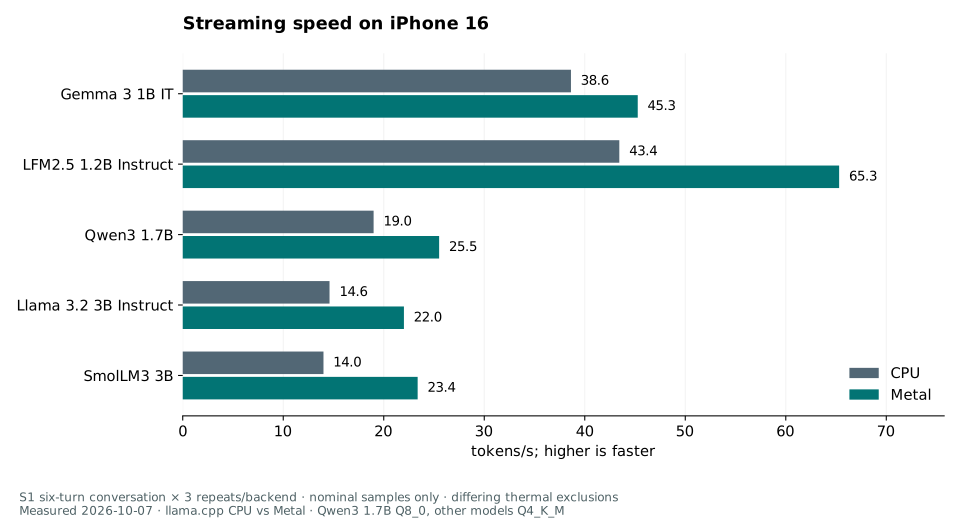
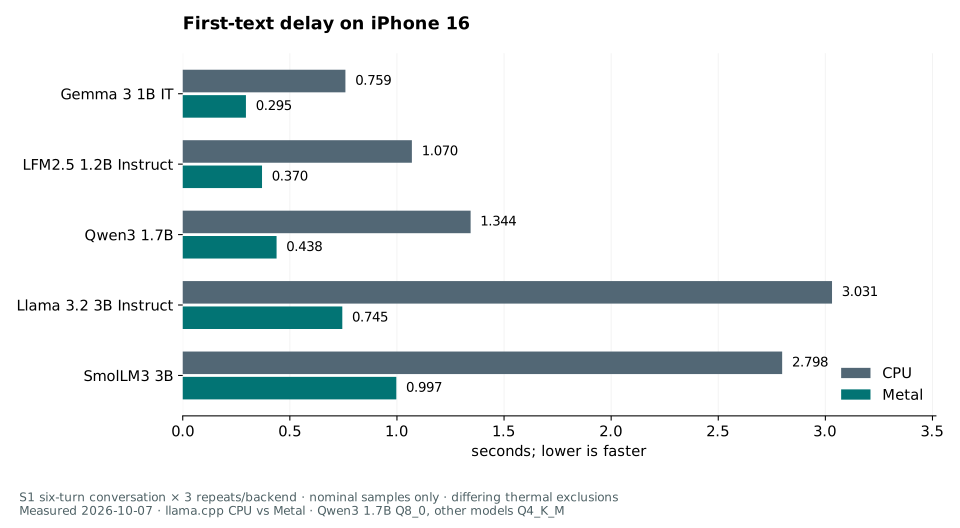
Metal started answering sooner and streamed faster in every tested model. LFM2.5 led streaming speed. Gemma started fastest, but often missed the requested reply format.
01 / Personal iPhone
Four metrics, side by side
Choose a measurement to compare CPU and Metal within each model. Different tokenizers and quantizations limit comparisons between models.
| Model | Backend | M1 First text seconds ↓ | M2 Streaming tokens/s ↑ | M3 Process peak MiB | M4 Facts correct/scorable | Strict format correct/observed | Nominal turns eligible/planned |
|---|---|---|---|---|---|---|---|
| Gemma 3 1B IT | CPU | 0.759 | 38.6 | 793.0 | 9/9 | 3/9 | 18/18 |
| Gemma 3 1B IT | 0.295 | 45.3 | 792.9 | 9/9 | 3/9 | 18/18 | |
| LFM2.5 1.2B Instruct | CPU | 1.070 | 43.4 | 720.8 | 9/9 | 9/9 | 18/18 |
| LFM2.5 1.2B Instruct | 0.370 | 65.3 | 720.9 | 9/9 | 9/9 | 18/18 | |
| Qwen3 1.7B | CPU | 1.344 | 19.0 | 1778.0 | 9/9 | 9/9 | 18/18 |
| Qwen3 1.7B | 0.438 | 25.5 | 385.8 | 8/8 | 8/8 | 17/18 | |
| Llama 3.2 3B Instruct | CPU | 3.031 | 14.6 | 1234.7 | 8/8 | 8/8 | 17/18 |
| Llama 3.2 3B Instruct | 0.745 | 22.0 | 401.5 | 8/8 | 8/8 | 17/18 | |
| SmolLM3 3B | CPU | 2.798 | 14.0 | 436.5 | 7/7 | 7/7 | 16/18 |
| SmolLM3 3B | 0.997 | 23.4 | 321.3 | 6/6 | 6/6 | 12/18 |
All configurations completed 3/3 conversations. Eleven warm turns were excluded from headline timing and recall. Memory requires a wholly nominal conversation, leaving 1 to 3 eligible conversations per configuration. Exact sample counts.
Show throughput and memory sample counts
| Model | Backend | Throughput turns / 18 | Memory conversations / 3 |
|---|---|---|---|
| Gemma 3 1B IT | CPU | 15/18 | 3/3 |
| Gemma 3 1B IT | Metal | 15/18 | 3/3 |
| LFM2.5 1.2B Instruct | CPU | 15/18 | 3/3 |
| LFM2.5 1.2B Instruct | Metal | 15/18 | 3/3 |
| Qwen3 1.7B | CPU | 15/18 | 3/3 |
| Qwen3 1.7B | Metal | 14/18 | 2/3 |
| Llama 3.2 3B Instruct | CPU | 14/18 | 2/3 |
| Llama 3.2 3B Instruct | Metal | 14/18 | 2/3 |
| SmolLM3 3B | CPU | 13/18 | 1/3 |
| SmolLM3 3B | Metal | 10/18 | 2/3 |
02 / Conversation history
Later replies take longer to start
On the sixth turn, the two 3B models took about 11 to 12 seconds to start a CPU reply, versus about 3.6 seconds on Metal. Later prompts are longer and ask different questions. This does not isolate history length alone.
| Model | Backend | Turn 1 | Turn 2 | Turn 3 | Turn 4 | Turn 5 | Turn 6 |
|---|---|---|---|---|---|---|---|
| Gemma 3 1B IT | CPU | 0.357 (n=3) | 0.636 (n=3) | 0.446 (n=3) | 0.875 (n=3) | 0.980 (n=3) | 2.594 (n=3) |
| Gemma 3 1B IT | Metal | 0.132 (n=3) | 0.243 (n=3) | 0.063 (n=3) | 0.291 (n=3) | 0.337 (n=3) | 0.896 (n=3) |
| LFM2.5 1.2B Instruct | CPU | 0.479 (n=3) | 0.999 (n=3) | 0.550 (n=3) | 1.157 (n=3) | 1.198 (n=3) | 3.752 (n=3) |
| LFM2.5 1.2B Instruct | Metal | 0.187 (n=3) | 0.320 (n=3) | 0.077 (n=3) | 0.432 (n=3) | 0.465 (n=3) | 1.291 (n=3) |
| Qwen3 1.7B | CPU | 0.565 (n=3) | 1.320 (n=3) | 0.668 (n=3) | 1.530 (n=3) | 2.283 (n=3) | 5.918 (n=3) |
| Qwen3 1.7B | Metal | 0.223 (n=3) | 0.435 (n=3) | 0.240 (n=3) | 0.591 (n=3) | 0.693 (n=3) | 1.690 (n=2) |
| Llama 3.2 3B Instruct | CPU | 1.307 (n=3) | 3.028 (n=3) | 1.575 (n=3) | 3.255 (n=3) | 3.595 (n=3) | 12.138 (n=2) |
| Llama 3.2 3B Instruct | Metal | 0.428 (n=3) | 0.717 (n=3) | 0.174 (n=3) | 0.996 (n=3) | 1.201 (n=3) | 3.565 (n=2) |
| SmolLM3 3B | CPU | 1.416 (n=3) | 2.778 (n=3) | 1.321 (n=3) | 3.279 (n=3) | 3.617 (n=3) | 11.439 (n=1) |
| SmolLM3 3B | Metal | 0.604 (n=2) | 0.927 (n=2) | 0.309 (n=2) | 0.997 (n=2) | 1.202 (n=2) | 3.550 (n=2) |
Each cell reports the median in seconds and nominal observations (n). Actual generated answers carry forward. Six turns run back-to-back with no simulated user pause.
Download all per-turn measurements03 / Method & boundaries
What we measured
- M1 / First text
- Seconds until the first text callback, including prompt preparation and detokenization. Median across eligible turns. Lower is faster.
- M2 / Streaming
- Generated tokens per second after generation begins. Replies shorter than eight tokens are excluded. Tokens are not equivalent to words across model tokenizers.
- M3 / Process footprint
- Whole-process memory sampled every 50 ms, including loading. Median of each wholly nominal conversation's maximum. This is not total CPU-plus-GPU device memory.
- M4 / Factual recall
- Correct/scorable probes at turns 3, 5 and 6. Strict reply format is scored separately. Three repeats of one conversation do not measure general model intelligence.
A synthetic workshop conversation
The fixture introduces four facts: Birch, Porto, 620 credits and vegan. Later turns add repeated logistics text and request fact recall. The longest recorded prompt was 1,594 tokens. Recall uses messages still inside the context window, not persistent memory beyond it.
Matched within each model
CPU and Metal use identical pinned GGUF bytes, the native chat template, retained prefix cache, greedy decoding, thinking disabled, a 2,048-token context and a 64-token reply cap. Qwen3 1.7B uses Q8_0. The other four models use Q4_K_M.
Temperature affects the headline
Only successful complete conversations contribute data. A timing or recall sample must start and end at nominal thermal state. Memory requires all six turns to stay nominal. All 90 raw recall probes were correct. After thermal exclusions, 82/82 eligible probes were correct. Gemma passed only 3/9 strict-format probes per backend.
Device and build
The personal iPhone 16 (iPhone17,3) ran iOS 26.6.2 build 23G90, with Low Power Mode off. Readiness was confirmed as unlocked, unplugged, cool and at least 60% charged. The signed Release build used Xcode 26.2 build 17C52, SDK 26.2 and llama.cpp commit b2e5e9b28b2484fbf94b543432ece638996a8b97. The five-model batch completed in 33.8 minutes including launches, cache verification and cooling. Downloads were separate.
04 / Separate Firebase pilot
The same workflow runs in the cloud
LFM2.5 1.2B completed one six-turn CPU conversation and one Metal conversation on two Firebase iPhone 16 Pro units. Actual OS: iOS 18.3.2 build 22D82. Both fresh 731 MB model downloads passed hash verification. All twelve turns stayed nominal.
| Model | Backend | M1 First text seconds ↓ | M2 Streaming tokens/s ↑ | M3 Process peak MiB | M4 Facts correct/scorable | Strict format correct/observed | Nominal turns eligible/planned |
|---|---|---|---|---|---|---|---|
| LFM2.5 1.2B Instruct | CPU | 1.173 | 40.0 | 716.8 | 3/3 | 3/3 | 6/6 |
| LFM2.5 1.2B Instruct | 0.367 | 65.3 | 723.6 | 3/3 | 3/3 | 6/6 |
One repetition per backend validates delivery. Separate physical phones were assigned, and cloud power and ambient conditions were not controlled. These results are not pooled with the personal iPhone study or used to isolate hardware effects.
Download Firebase pilot (CSV)Qwen3 0.6B protocol pilot
The initial pilot completed six conversations and 36 turns on the personal iPhone, all nominal. It finalized scoring before the five-model protocol was frozen.
| Model | Backend | M1 First text seconds ↓ | M2 Streaming tokens/s ↑ | M3 Process peak MiB | M4 Facts correct/scorable | Strict format correct/observed | Nominal turns eligible/planned |
|---|---|---|---|---|---|---|---|
| Qwen3 0.6B | CPU | 0.633 | 57.8 | 407.0 | 9/9 | 6/9 | 18/18 |
| Qwen3 0.6B | 0.200 | 96.3 | 400.9 | 9/9 | 6/9 | 18/18 |
05 / Reproduce & inspect
The numbers are downloadable
The public observations contain every measured turn, including thermal exclusions, generated replies, format outcomes and source-report hashes. Device identifiers, host paths, signing material and private archive locations are omitted.
Recalculate the published tables
Download the reproduction bundle, extract it and run the command below. Python 3.9 or later is sufficient, with no third-party packages or network access. It recomputes the medians, exclusions and frozen factual scores and checks every published summary and turn-table value.
python3 reproduce.pyFull signed test bundles and provider logs remain in private storage. The public export is sufficient to audit the reported aggregates, with exact measured native source inputs available separately. A new native run requires the model files, pinned native dependency and an appropriately signed iPhone build.
Protocol: openweights-ios-publication-v1 · Measured 7 October 2026 · Published 8 October 2026